Every building moves as it ages. Concrete cures, soil shifts, seasons change, and the foundation is usually the first place that shows it.
For property managers overseeing occupied multifamily or commercial buildings across New Jersey, a new crack in a basement wall raises one immediate question: is this cosmetic, or is it the start of something worse? The crack itself rarely gives a full answer. What matters more is behavior over time, and the symptoms that show up alongside it.
Guessing wrong on a foundation issue in an occupied building isn’t a minor mistake. It can mean liability exposure, tenant complaints, or a small repair turning into a structural one.
What Crack Patterns Actually Tell You
Direction and shape are the first clues. Two cracks of identical width can mean two completely different things depending on which way they run.
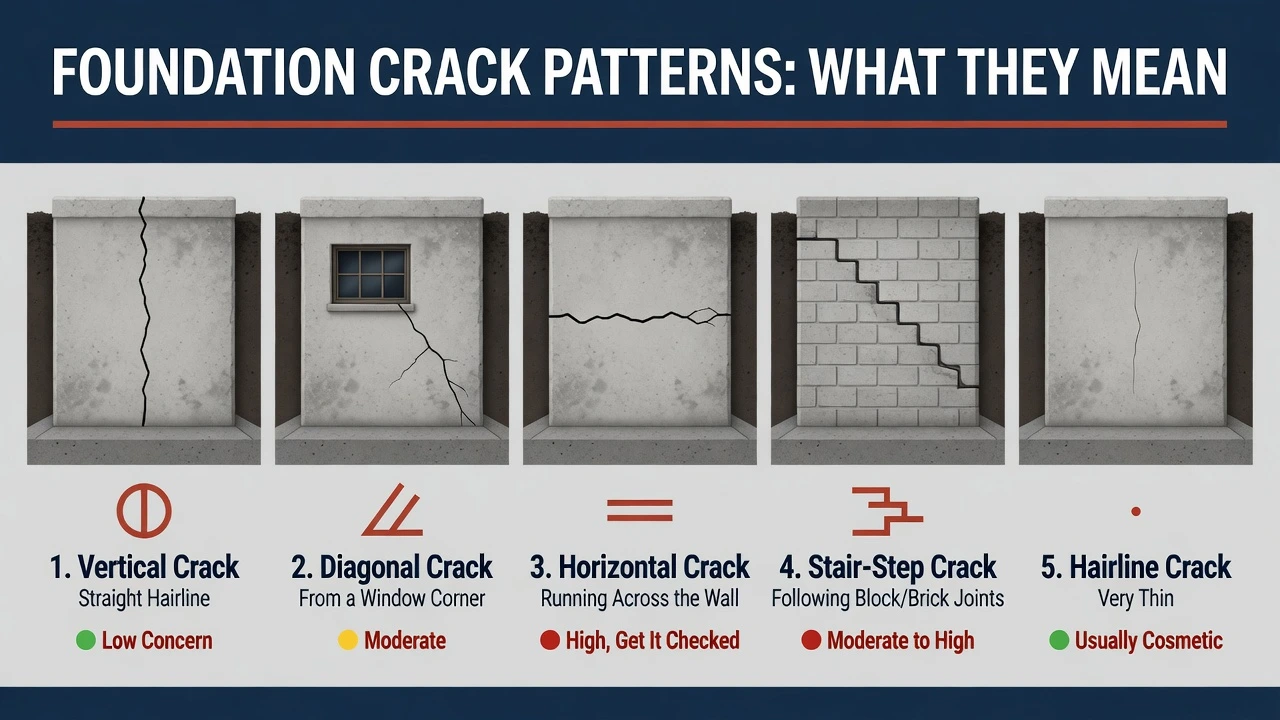
| Crack Type | Typical Cause | Concern Level |
|---|---|---|
| Vertical | Curing shrinkage, minor settling | Low, unless widening or leaking |
| Diagonal | Uneven settlement near openings | Moderate, watch for paired symptoms |
| Horizontal | Soil or hydrostatic pressure | High, professional review recommended |
| Stair-step | Settlement or moisture behind wall | Moderate to high |
| Hairline | Normal curing | Low, unless it reappears or weeps |
Vertical cracks run straight up and down, sometimes with a slight lean. In poured concrete foundations, these are the most common and generally the least concerning. They become worth a second look when they widen, weep water, or one side sits noticeably higher than the other.
Diagonal cracks angle off from window or door corners and are usually wider at one end. On buildings we’ve assessed across Bergen and Passaic County, these often show up near openings where the foundation settled unevenly under one section of the structure.
Horizontal cracks deserve immediate attention. A horizontal line in a foundation wall almost always means soil or hydrostatic pressure is pushing in from outside, and that pressure doesn’t resolve on its own. Left unaddressed, these tend to progress into wall bowing.
Stair-step cracks follow mortar joints in block or brick foundations, climbing in a jagged pattern. They generally signal uneven settlement or sustained moisture pressure behind the wall, and repairs here often overlap with dedicated masonry restoration work.
Hairline cracks are thin, often under an eighth of an inch, and common in both new construction and older buildings. Most are cosmetic. One that reappears after sealing, or starts weeping moisture, isn’t cosmetic anymore.
When a Crack Stops Being Cosmetic
A crack rarely acts alone when there’s a real structural issue behind it. The surrounding symptoms often tell you more than the crack itself. Doors that suddenly stick. Windows that won’t latch. Floors that feel slightly sloped underfoot. Gaps opening between walls and ceilings, or around door frames, where one side keeps widening faster than the other.
Water changes everything. A damp patch, a persistent musty smell in a basement unit, moisture tracking through a crack line. Even a narrow leaking crack can accelerate deterioration and feed mold growth in occupied buildings, which is why crack repair and waterproofing are so often handled as one project.
What’s Actually Causing the Crack
Three forces are usually behind foundation cracking, and more than one is often at play. Construction quality is the first: inadequate soil compaction before the foundation was poured, weak concrete mix, or thin reinforcement can leave a wall prone to early cracking.
Water and drainage come second, and in our experience this is the most common driver on older NJ multifamily properties. Saturated soil expands and presses against foundation walls, which is a leading cause of horizontal cracking. Clogged gutters, poor grading, and downspouts discharging too close to the foundation all feed this directly.
Soil movement is the third factor. Clay-heavy soil common across parts of northern New Jersey swells when saturated and shrinks in dry stretches, and that repeated cycling shifts sections of a foundation unevenly over years.
Freeze-thaw adds a fourth layer specific to the region. Water enters a small gap, freezes, expands, and widens it a little more with each winter. On buildings we’ve serviced that are 40 or more years old, this cycle is often the reason a hairline crack from decades ago has slowly become a quarter-inch gap today.
Is It Stable, or Is It Moving?
Width matters less than most people assume. What matters is whether a crack is holding steady or actively changing. Mark both ends of the crack, note the date, and photograph it monthly. If it hasn’t moved in that window, it’s likely a settled, historical crack.
The American Concrete Institute’s own reference tables note that in reinforced concrete exposed to soil and moist air, engineers generally treat crack widths of around 0.012 inches, roughly a hundredth of an inch, as the reasonable upper bound under normal service conditions, though it’s warned that “a significant portion” of cracks in a structure can exceed these values over time. That’s a design benchmark, not a field diagnosis. A thin vertical crack that’s actively leaking can matter more in practice than a wider one that’s bone dry and hasn’t moved in years. (source: ACI)
Tip: Photograph the crack in daylight with a coin or ruler placed next to it for scale. This makes month-over-month comparisons far more reliable than memory or rough estimates.
DIY Sealing vs. Calling a Professional
Small, stable, dry cracks are reasonable candidates for DIY sealing. If a crack hasn’t grown, isn’t letting water through, and isn’t paired with sticking doors or sloped floors, sealing it for appearance or minor moisture control is a fair call.
The limitation is that sealant treats the surface. It doesn’t touch whatever is pushing on the wall from outside. If a crack keeps growing, leaks after sealing, or shows up alongside other movement, the pressure behind it is still active.
This distinction matters more in commercial and multifamily buildings than in a single-family home. An undiagnosed foundation issue in an occupied building carries habitability and liability exposure that a homeowner’s weekend patch job was never built to handle.
Some contractors will clear a crack as harmless based on a visual check alone. For buildings over 30 years old, we typically recommend a moisture reading as well, even when the crack itself looks minor, since surface appearance doesn’t always reflect what’s happening inside the wall.
How These Get Repaired
The method depends on what’s actually driving the crack, not just how it looks. For narrow, non-moving cracks, epoxy or polyurethane injection seals the gap from the inside. Epoxy is typically used for structural bonding, while flexible polyurethane suits cracks where water intrusion is the primary concern.
Where a wall is bowing or a crack keeps reappearing, reinforcement becomes necessary, usually carbon fiber strapping or wall anchor systems. Because water pressure is so often the actual root cause, a durable fix usually pairs crack repair with below-grade waterproofing rather than treating them as separate jobs.
Reducing the Risk Going Forward
Most prevention comes down to keeping water away from the foundation and catching movement early. Clear gutters and downspouts routed well away from the building reduce the standing water and saturated soil that drive pressure against foundation walls.
Periodic inspection, with dated photos of any existing cracks, catches gradual movement before it becomes a bigger repair.
Most foundation cracks aren’t an emergency. The ones worth acting on are the ones that are moving, leaking, or showing up with other signs of stress in the building around them. For NJ property owners managing occupied commercial or multifamily buildings, a professional assessment costs far less than waiting to find out the hard way which category a crack falls into.
Adriatic Restoration serves commercial and multifamily properties across New Jersey. Call (201) 338-4642 to schedule a building assessment.
FAQs
How can you tell if a foundation crack is structural?
Look for width over a quarter inch, horizontal orientation, or a crack paired with bowing walls, sloped floors, or sticking doors.
Are vertical cracks in a foundation normal?
Usually. They typically come from settling or curing shrinkage and stay harmless unless they widen or start leaking.
Which crack types are the most serious?
Horizontal and stair-step cracks. Both usually point to active soil or water pressure that tends to worsen over time.
Can a foundation crack be repaired without a contractor?
Only if it’s small, dry, and hasn’t changed in size. Anything growing or leaking needs a professional root-cause repair.
Does sealing a crack actually fix the problem?
It stops surface moisture, not the pressure behind it. If the underlying cause is still active, the crack usually comes back.