
Below Grade Waterproofing Services in New Jersey
Urethane and epoxy injection, negative-side sealing, and foundation leak repair for basements, retaining walls, elevator pits, and structures below ground level.
When the Water Is Coming From Underground
Above ground, walls only get wet when it rains. Below grade, your foundation sits in damp soil year-round with groundwater pushing against it constantly — and after every NJ storm, that hydrostatic pressure spikes. Water under pressure will find any crack, cold joint, or pipe penetration and force its way through. Adriatic Restoration has been sealing below grade structures across New Jersey since 1982.
Our Below Grade Waterproofing Services
When excavating the exterior isn’t practical, we stop water from the inside:
- Urethane injection for active, leaking cracks
- Epoxy injection for structural crack repair
- Below grade foundation waterproofing (negative-side interior systems)
- Basement wall and floor leak repair
- Cold joint and floor-to-wall joint sealing
- Pipe penetration and tie-rod hole sealing
- Retaining wall crack injection and sealing
- Elevator pit waterproofing
- Suspended pool deck leak treatment
- Crystalline waterproofing application on concrete
- Cementitious waterproof coating systems
- Below grade leak investigation and water testing
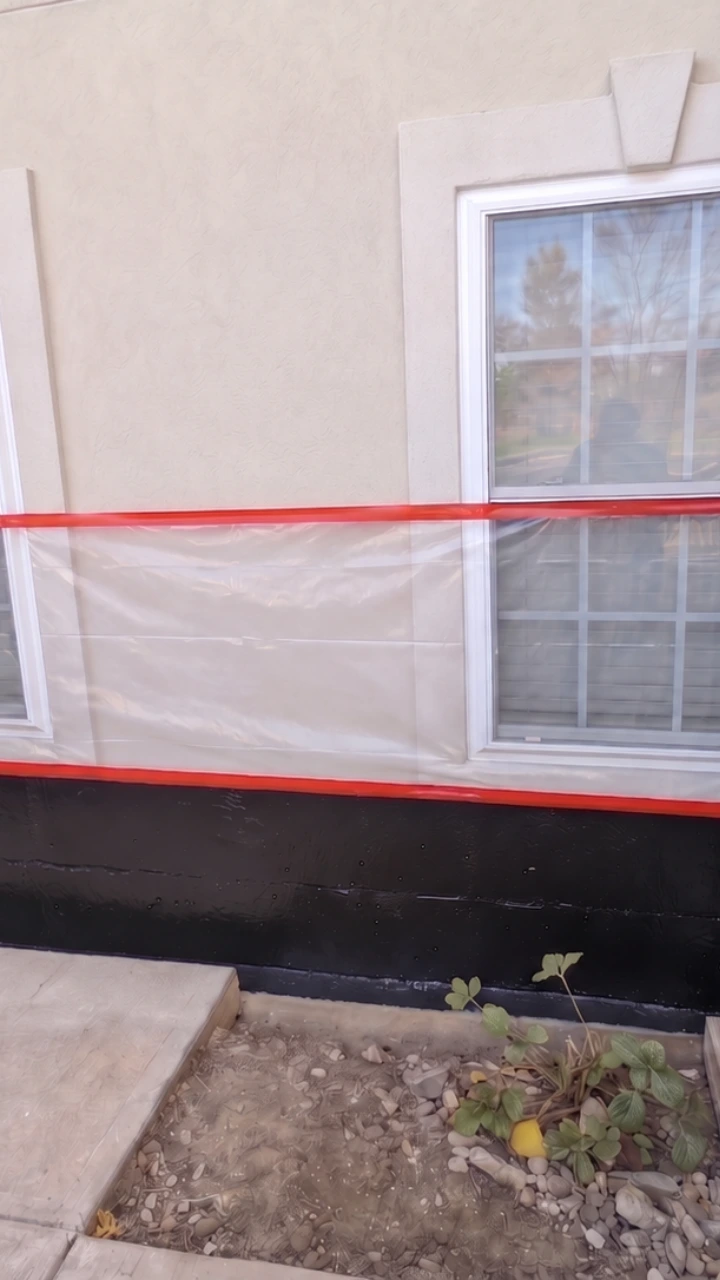
Three Steps From Wet Basement to Dry Concrete
Step 1: Find Where the Pressure Is Winning
=Groundwater enters at predictable weak points — shrinkage cracks, cold joints, pipe penetrations, and the floor-to-wall joint. We inspect the full below grade envelope, identify every active and dormant entry point, and give you a written scope with exact pricing for what your foundation actually needs.
Step 2: Inject and Seal From the Inside
When exterior excavation isn't possible, we work from the negative side. Active leaks get expanding urethane injection that chases water through the crack and seals it permanently; structural cracks get epoxy injection that restores the concrete's strength. Joints, penetrations, and porous walls get the right sealing system on top.
Step 3: Verify Dry and Confirm It Stays Dry
Injection work is only done when the leak is actually dead — so we verify each repair, water-test where conditions allow, and walk the completed work with you. You get clear documentation of what was sealed and guidance on drainage habits that keep pressure off your foundation long-term.
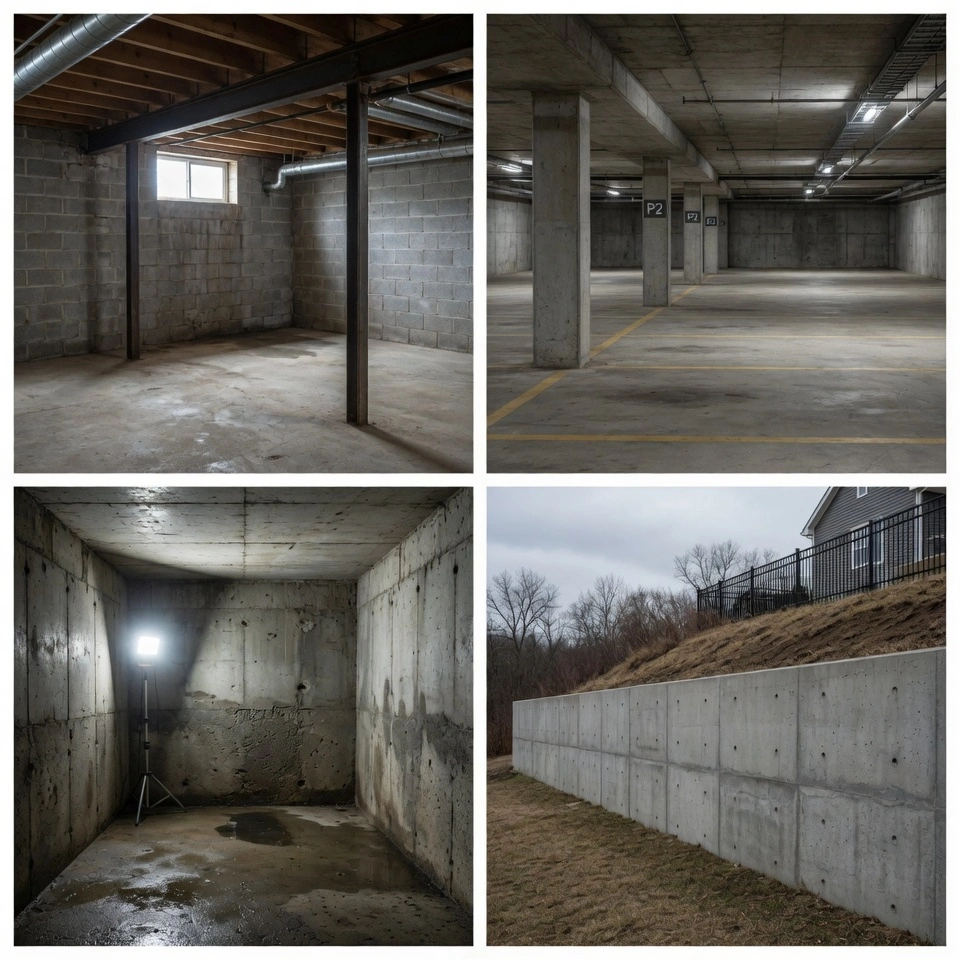
Below Grade Structures We Waterproof
Residential Basements: Leaking foundation cracks, damp walls, and seeping floor joints in NJ homes — sealed from inside without tearing up your landscaping or driveway.
Apartment and Condo Buildings: Below grade parking, storage levels, and laundry rooms where chronic leaks damage finishes and equipment. We work with managers to phase repairs around resident access.
Commercial Buildings: Basements, loading docks, and mechanical rooms where water threatens inventory and systems. Elevator pits are a specialty — a code and safety issue most waterproofers won’t touch.
Parking Structures and Pool Decks: Suspended slabs over occupied space leak into whatever’s below. We inject and seal from the accessible side with minimal disruption above.
Retaining Walls: Site walls holding back saturated NJ soil crack under constant pressure. Injection sealing stops the leaking and, with epoxy, restores structural integrity in the same visit.
Positive Side vs. Negative Side: Why Interior Waterproofing Works
Positive-side waterproofing means sealing the wall on the side the water touches — the exterior. It’s the textbook approach, but it requires excavating down to the footing. Next to a property line, under a sidewalk, beside a neighboring building, or below an occupied structure, that’s often impossible or wildly expensive.
Negative-side waterproofing seals the wall from inside the building — and it’s the specialty most contractors don’t have. Done right, it doesn’t just block water at the surface; injection resins travel into the crack itself, expanding and curing within the wall to cut the water path off inside the concrete.
Urethane injection is for water that’s actively moving. The resin reacts with the water itself, foaming and expanding to fill the entire crack — even ones that twist and branch inside the wall.
Epoxy injection is for cracks that compromise the structure. It bonds the concrete back together at strengths often exceeding the original pour, repairing and sealing in one operation.
This is why a leaking basement, retaining wall, or suspended pool deck rarely needs excavation. The fix comes from the inside — if the contractor knows how to do it.
Below Grade Waterproofing Across North and Central Jersey
Below grade waterproofing is one of the most common projects we handle across northern and central NJ. We serve Bergen County, Hudson County, Essex County, Passaic County, Union County, Middlesex County, Morris County, and Monmouth County.
Towns we frequently work in: Paramus, Hackensack, Fort Lee, Englewood, Ridgewood, North Bergen, Jersey City, Hoboken, Newark, Montclair, Clifton, Paterson, Morristown, Edison, East Rutherford, and surrounding communities.
Not sure if we cover your area? Call (201) 338-4642 and we’ll let you know straight away.
Injection Work Is a Craft — We've Practiced It for 40 Years
Crack injection looks simple and fails constantly in inexperienced hands — wrong resin, wrong pressure, ports spaced wrong, and the leak returns in months. Adriatic Restoration has been one of the trusted below grade waterproofing contractors in New Jersey since 1982. We’re licensed, insured, and we know which cracks need urethane, which need epoxy, and which need neither.
Because we’re a full restoration contractor, we also see what injection-only companies miss: a leaking foundation often signals drainage, masonry, or structural issues that need attention too. We address the whole picture — and for everything above the ground line, our complete Masonry Repair and Waterproofing services are handled by the same company.
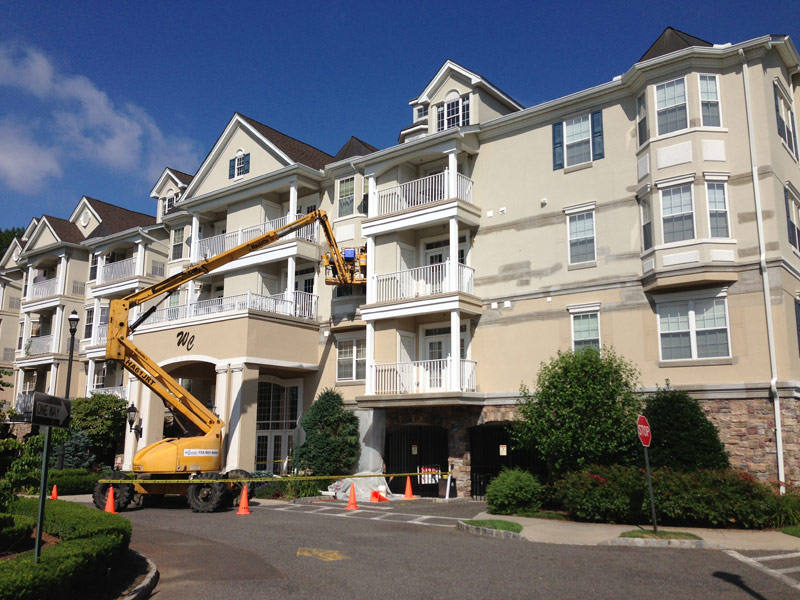
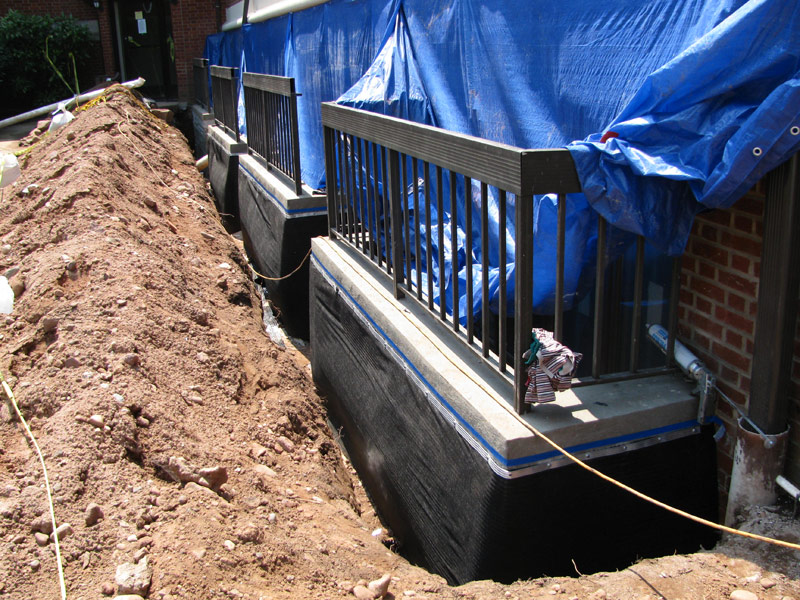
Recent Works


What NJ Property Owners Ask About Below Grade Leaks
Can you stop a foundation leak without digging outside?
What's the difference between urethane and epoxy injection?
Is a leaking basement crack a structural problem?
How long does injection repair last?
Why does my basement only leak during heavy rain?
Groundwater Never Takes a Day Off — Neither Does the Damage
Get a free below grade inspection and find out exactly where your foundation is letting water in, from the team sealing NJ basements since 1982.