Concrete Structural Repair Services in New Jersey
Adriatic Restoration repairs damaged concrete on commercial and multifamily buildings across northern and central New Jersey. We find the cause of the damage first, then restore the structure so the repair lasts.
What Is Concrete Structural Repair?
Concrete structural repair is the process of restoring concrete that has lost strength from cracking or steel corrosion. The work removes damaged concrete and repairs the reinforcing steel inside it. The repair rebuilds the damaged section and is intended to restore structural integrity.
Adriatic Restoration provides concrete structural repair services in New Jersey for condo associations and commercial building owners. We work from 55 Union Pl #122, Summit, NJ 07901, and serve residential and commercial properties serving northern and central New Jersey, including Bergen, Hudson, Essex, Passaic, Union, Middlesex, Morris and Monmouth counties.
What Causes Concrete Damage in New Jersey Buildings?
Freeze-Thaw Cycles
Winters here swing above and below freezing many times each season. Water in the pores of the concrete freezes and expands. Each of these freeze-thaw cycles opens tiny cracks a little wider.
Salt Air Along the Coast
Buildings on the Hudson River waterfront in Jersey City and Hoboken face salt air on top of road salt. Properties near the Jersey Shore in Monmouth County see the same exposure on balconies and railings. This can contribute to concrete damage.
De-Icing Salt and Chloride Intrusion
Road salt adds a second problem. Cars track salt into parking garages, and crews spread it on sidewalks and entry plazas. This salt drives chloride intrusion into the slab. Chlorides break down the thin film that keeps rebar from rusting. Past a certain level, rebar corrosion begins even in sound-looking concrete.
Carbonation in Older Buildings
Old buildings often experience carbonation problems. Air naturally has carbon dioxide, which has an acidic nature. Concrete has an alkaline pH, but its interaction with carbon dioxide decreases the pH level. The steel loses its protection when it’s exposed to air.
Stop Structural Concrete Damage Before it Gets Worse
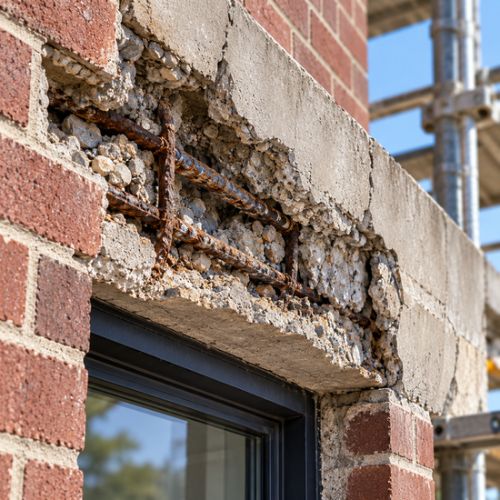
A small crack on a balcony slab looks harmless, but water carries salt through that crack down to the steel inside. Rust takes up far more room than the steel it replaces, so it pushes the concrete apart from within.
We provide concrete structural repair in New Jersey for buildings where this process has already started. Our crews remove the weak concrete and treat the steel. Then we rebuild the section and protect it from the next round of water and salt.
Adriatic Restoration has provided concrete, balcony, and exterior restoration services in New Jersey for more than four decades. Foundations and sidewalks are part of the same work.
Warning Signs of Structural Concrete Damage
Owners who search for structural concrete repair services in NJ usually notice one of these signs first.
Spalling
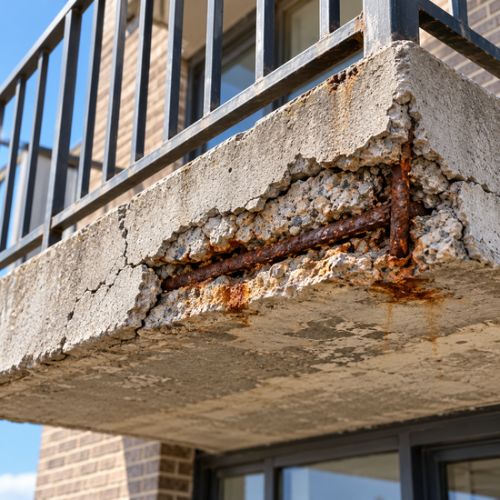
Flakes or chunks of concrete that break off the surface.
Rust stains
Brown streaks that bleed out from cracks or joints.
Exposed rebar
Bare steel at slab edges or column corners.
Hollow sounds
A dull sound when tapped, shows delamination below the surface.
Growing cracks
Cracks that widen over time or reopen after a past patch.
Sagging slabs
Visible dips in balcony slabs or beams.
Ceiling leaks
Water dripping through a garage ceiling or a podium deck.
Exposed rebar repair in New Jersey should start with a survey of the whole area. The visible spot is often only the edge of a larger delamination.
How Do We Repair Structural Concrete?
- Condition Evaluation: The team checks the concrete and maps every hollow area. We also take cover meter readings and test carbonation on site.
- Lab testing: We send concrete cores and chloride samples to an independent lab to show how far salt has reached.
- Engineering: Our experts follow the owner’s engineer or bring in a licensed engineer from our partner network. Repairs follow ACI CODE-562 and the NJ Uniform Construction Code Rehabilitation Subcode.
- Shoring and Removal: A professional team will shore the structure and remove weak concrete down to sound material. They clear at least 3/4 inch behind the bar.
- Steel treatment: Experts clean the rust and splice new steel where bars have lost too much thickness. Galvanic anodes are used if chloride level is high.
- Surface Preparation: We prepare the surface to the right ICRI concrete surface profile (CSP), then place and cure the repair material.
- Protection: We finish with sealers or traffic coatings, or our concrete waterproofing systems.
Concrete Repair and Restoration Services in New Jersey
Concrete Repair
General concrete repair covers minor problems such as cracks, chipping, and flaking. It also includes delaminations on slabs, columns, beams, and walls. Shallow damage gets a partial-depth repair with polymer-modified repair mortar. Serious damage gets a form-and-pour repair. Our professionals add new concrete behind the temporary forms for utmost strength.
Concrete Balcony Repair
Sometimes, water can collect at railing post pockets and at the slab edge. This is a major factor contributing to steel corrosion. Our concrete balcony repair work restores slab edges and post pockets, along with the soffit below.
Our team has proper training and licensing for concrete balcony repair in Hoboken, where salt air speeds up damage. You should get new waterproofing services for better outcomes.
Concrete Resurfacing
Resurfacing refers to the application of a thin bonded overlay to worn-out concrete. It fixes scaling and light pitting on plazas or walkways. Requests for concrete resurfacing in Bergen County often come from retail centers and office parks with heavy foot traffic.
Resurfacing does not fix delamination or rusting steel, so always ask for an inspection of the foundation.
Sidewalk Repair
Cracks or chipping of the sidewalks are a prominent risk. Many local authorities adopt ordinances that make the adjacent property owner responsible for sidewalk upkeep. Some towns issue repair notices after an inspection and set a deadline to complete the work.
Owners should check the local ordinance, since rules differ from town to town. Contact our sidewalk repair team to replace the failed panels to match the grade. We also handle the drainage and curb lines.
Epoxy Injection
Epoxy injection fills a crack with a low-viscosity resin that joins the two faces back together. It can restore strength within a dormant crack in a wall or beam. Are you looking for an epoxy crack injection service? Adriatic Restoration is available for support!
Epoxy only works on cracks that have stopped moving. An active crack will crack again with the use of epoxy. Active cracks often need a flexible polyurethane injection.
Foundation Repair
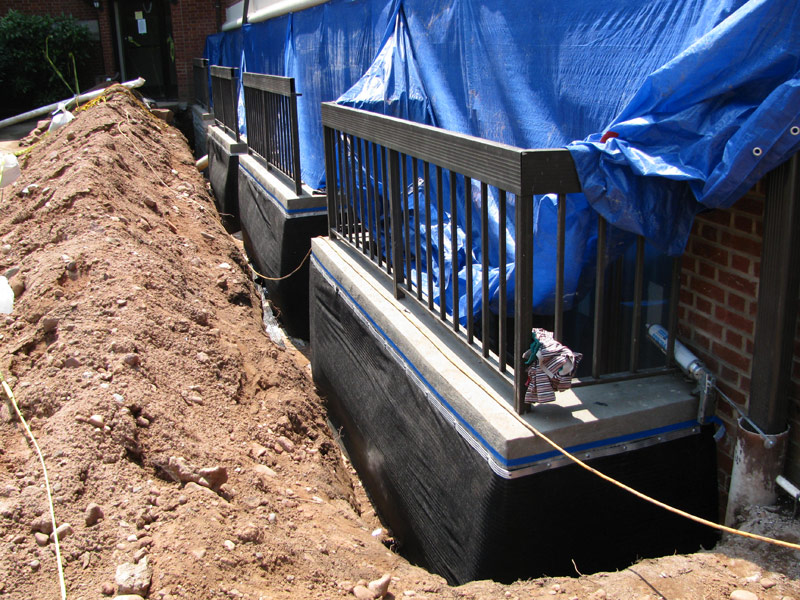
Foundation walls and footings crack from settlement or water pressure. Shrinkage during the original cure adds its own cracks. Our foundation repair work seals and strengthens those cracks and restores damaged wall sections.
Calls about foundation crack repair near Morristown often involve water entry at the same crack. We treat the repair and the waterproofing as one job.
Parking Garage Restoration
Parking structures combine nearly every cause of concrete damage in one place. Salt and standing water attack the deck while traffic wears it down. Our parking garage restoration projects cover deck repair and expansion joints, followed by traffic-bearing membranes.
Teams that need parking garage concrete repair in Hackensack usually keep the garage open. We phase that work so only part of the deck closes at a time.
Halo Effect and Early Concrete Patch Failure
A new patch can speed up corrosion in the old concrete around it. Engineers call this the halo effect or the ring-anode effect. The new patch is clean and free of salt, so the steel inside it stays protected.
The steel just outside the patch still sits in salty concrete. That difference sets up a small electrical cell, and the steel at the patch edge corrodes faster than before.
The result is a ring of new spalls around an old patch, often within a few years. Crews reduce the risk by removing chloride-heavy concrete or by embedding galvanic anodes at the patch edge.
Explore Our Masonry Services



Service Areas
Adriatic Restoration serves properties throughout New Jersey, with projects across Bergen, Hudson, Essex, Passaic, Union, Middlesex, Morris, Ocean, and Monmouth counties.
Our service area includes communities such as Hackensack, Fort Lee, Jersey City, Hoboken, Newark, Montclair, Summit, Elizabeth, Morristown, Parsippany, Clifton, Paterson, Edison, New Brunswick, Red Bank, and Long Branch, along with many surrounding towns and cities.
Contact us to confirm service availability in your area.
Why Choose Adriatic Restoration for Masonry Work
Adriatic Restoration is a licensed and insured masonry contractor with more than four decades of experience restoring and repairing buildings throughout New Jersey. We understand how masonry systems deteriorate and provide repairs that address the cause of the problem, not just the visible damage.
Every project begins with a thorough inspection so we can identify issues such as moisture intrusion, deteriorated mortar, structural movement, or failing flashing before recommending the right repair. Our goal is to deliver durable masonry repairs that help protect your building for years to come.
We provide detailed estimates, clear communication, and quality workmanship from start to finish. Using compatible materials and proven restoration methods, our experienced team completes every project with lasting results and stands behind the work we perform.
Recent Works


Frequently Asked Questions - Concrete Structural Repair
How long does a concrete structural repair last?
Repair longevity varies with the original condition, repair method, exposure, waterproofing, maintenance, and whether the underlying cause of deterioration has been corrected.
Do I need a permit for concrete repair in New Jersey?
Many structural concrete repairs require a permit under the state Uniform Construction Code. The Rehabilitation Subcode sets the technical rules for repair work on existing buildings. The local construction official decides permit needs for each project, so owners should confirm before work begins.
Can concrete repairs take place in winter?
Cold-weather concrete repair is possible with extra steps. Cement-based materials need protection from freezing while they cure, so crews use heated enclosures or schedule exterior work for milder months.
What is the difference between spalling and scaling?
Spalling is the loss of larger concrete pieces, usually caused by rusting steel pushing the concrete apart. Scaling is the loss of a thin surface layer, usually caused by freeze-thaw cycles and de-icing salt. Spalling often signals a structural concern, while scaling is mostly a surface issue.
Is epoxy injection a structural repair?
Epoxy injection can restore strength across a dormant crack by bonding the two faces back together. It does not work on cracks that are still moving. An engineer should confirm the cause of the crack before injection.
Book a Concrete Structural Repair in New Jersey
Do not neglect the rust stains or hollow-sounding slabs. Contact our team now to check the strength and hollowness of your building’s concrete. Our team explains the extent of the damage and helps decide the next step. We offer competitive prices and exceptional services for every customer.